U060F means the engine control module (ECM) lost the digital conversation with mass air flow sensor A. It is a network code (the U prefix), and that single letter changes the whole diagnosis. The old analog MAF codes P0100 through P0104 describe a voltage or frequency that went out of range. U060F describes a message that stopped arriving. Nothing in the definition says the sensor is bad, and on the vehicles that set this code most often, replacing the sensor first is the most common way to spend money without fixing anything.
Severity: moderate. Can you keep driving? Yes, for a short distance. The engine runs on a substitute air flow value, so expect rough idle or reduced power, but there is no immediate risk to the engine. Do not drive for weeks on it: a lean substitute value can damage the catalytic converter over time.
What kind of sensor sets a communication code
A classic hot-wire MAF sends the ECM an analog voltage or a frequency. It cannot "lose communication" because there is no communication to lose. U060F only exists on vehicles where the air flow sensor is a smart sensor: a small circuit board inside the sensor digitizes the reading and sends it to the ECM over a serial link.
Two links are common:
- SENT (Single Edge Nibble Transmission, SAE J2716) on many Mitsubishi, Hyundai and Kia engines. Mitsubishi's own service information for U060F-00 describes the set condition as a SENT communication timeout or data errors lasting 2 seconds, with the power mode on for more than 2 seconds and battery voltage between 10.0 and 16.5 V.
- LIN (Local Interconnect Network) on recent General Motors engines, including the 4.3 L LV3, 5.3 L L84 and 6.2 L L87. This is why U060F on a GM truck almost always arrives with U1346, the LIN bus communication code, and often with P0102, MAF circuit low.
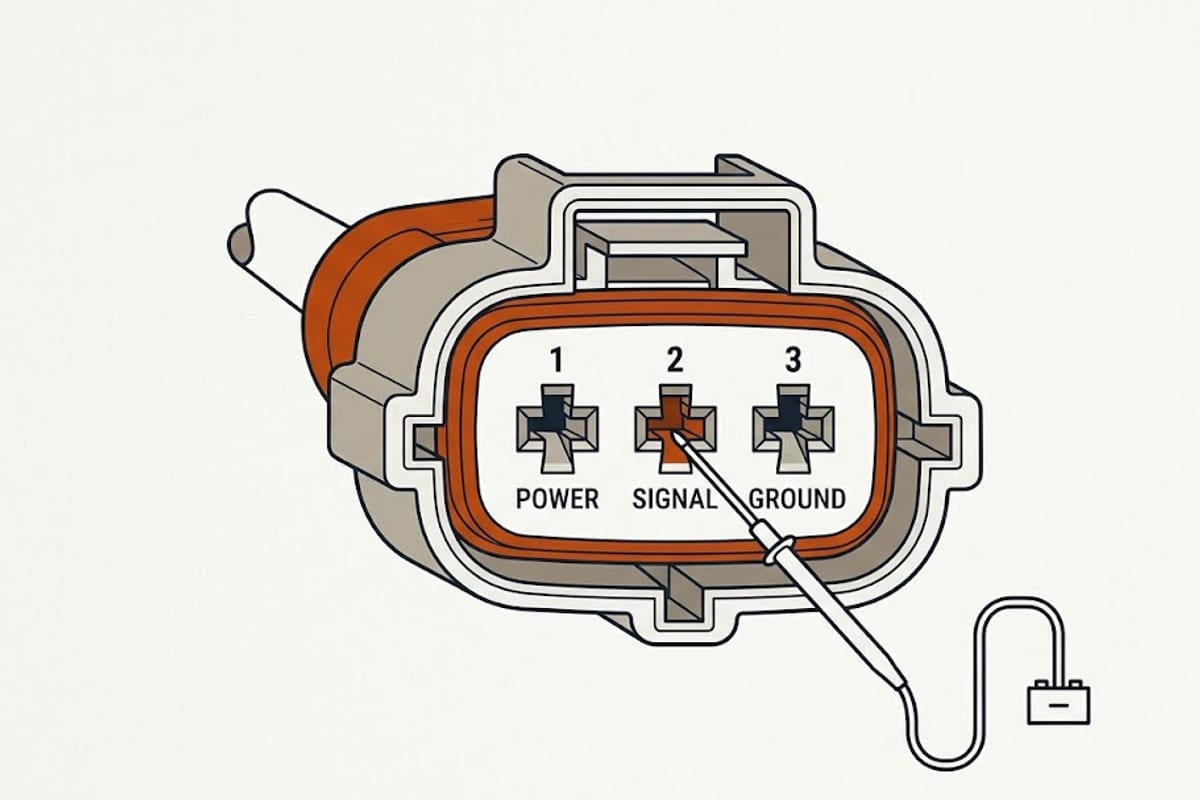
The practical consequence is that the sensor has three or four wires, not five or six: power, ground, the serial line, and sometimes a separate intake air temperature output. Every one of those wires is a candidate, and the serial line is the one most sensitive to damage, because a single intermittent open on it stops every message.
The set conditions, in plain language
The ECM expects a message from the sensor on a fixed schedule, typically several times per second. When the messages stop, or arrive with checksum errors, for a continuous window (2 seconds on the Mitsubishi calibration), the module records U060F and substitutes a calculated air flow value from throttle position and engine speed.
Two things follow from that:
- The engine usually still runs. The substitute value is coarse, so expect a rough idle, hesitation, a lean or rich fuel trim, and on GM trucks a reduced power message. Any of these can appear without a flashing light. If the light is flashing, that is a misfire, not this code; see why a flashing check engine light means stop.
- The code can be intermittent. A connector that opens under vibration or when the harness is hot will set U060F, clear itself as a history code, and set again on the next drive. Read the freeze frame before clearing anything: the engine temperature and vehicle speed recorded at the moment of the fault tell you whether it happens cold, hot, at idle or on rough roads.
Causes, in the order they are actually found
Water in the MAF connector. GM bulletin 24-NA-158 (September 2024) covers 2023 to 2024 Chevrolet Tahoe and Suburban, GMC Yukon and Cadillac Escalade with the L84 or L87 V8. The condition is the check engine light with active P0102 and possibly U060F and U1346. The stated cause is water infiltration in the MAF connector during assembly. The correction is not a sensor alone: the bulletin replaces the MAF sensor (part 12714453) and the connector with a service connector kit (85519071), at a labor time of 1.0 hour, and tells the technician to reuse the connector dress cover. If the truck is in that range and the connector shows green or white corrosion on the terminals, this bulletin is the diagnosis.
A damaged wire in the MAF harness. On a 2021 Silverado 1500 with the 4.3 L engine, a technician on the Diagnostic Network reported U060F with U1346 and reduced power, resistance checks that passed, and no change after installing a new OEM sensor. The fault turned out to be a section of the LIN wire with swollen, heat-damaged insulation where the harness ran near a heat source. Cutting out the damaged section and splicing it fixed both codes. A related known pattern on GM trucks is a harness zip tie pulled too tight, which breaks the wire internally as the engine rocks; the insulation looks fine and the copper is broken.
Loss of power or ground to the sensor. The sensor's electronics need a clean supply. A corroded ground eyelet or a fuse that feeds several sensors will silence the link even though the sensor is perfect. Mitsubishi's procedure checks the power line from MAF terminal 1 to ECM terminal 76, the ground from terminal 3 to ECM terminal 98, and the signal line from terminal 2 to ECM terminal 87, each for open, short and physical damage.
Low system voltage. Digital sensors reset below their operating threshold. A weak battery that dips hard during cranking can set U060F on a cold morning and never again that day. If the code appears with several other U codes at once, especially after the vehicle sat, the battery and the charging system come before anything else. The reasoning is the same as for U codes in general: a whole group of modules does not fail at once, but their shared power can.
The sensor itself. It does fail, and when it does the code is usually solid, not intermittent, and the live data shows no air flow at all with the engine running. Oil contamination from an oiled aftermarket air filter is a known way to kill the electronics.
The ECM. Last on every manufacturer's list, and only after the wiring has passed every test and the fault persists after an OBD-II drive cycle with a known-good sensor.
A diagnostic order that does not waste a sensor
- Record everything before clearing. Note whether U060F is current or history, which codes sit beside it (P0102, U1346, other U codes), and the freeze frame data.
- Look at live air flow data. On a scan tool, watch the MAF reading. A sensor that reports plausible grams per second with the code in history is an intermittent wiring fault. A reading stuck at zero or at a substitute value with the code current is a live loss of communication.
- Open the connector. Pull it and look at the terminals with a light. Moisture, green corrosion, a pushed-back terminal, or a wire that moves too freely at the seal each explains the code by itself. On the 2023 to 2024 GM V8 trucks, corrosion here means the bulletin applies.
- Check power and ground at the sensor connector, key on. Battery voltage on the supply pin and under 0.1 V of drop on the ground pin. No supply means a fuse or a splice upstream, not the sensor.
- Wiggle-test the harness with the engine running. Watch the live MAF reading while flexing the harness where it passes near the exhaust manifold, the engine lift bracket and any tie-downs. A dropout while flexing pinpoints the damaged section.
- Check the serial line for continuity and for shorts to ground and to power. Resistance end to end should be under an ohm. Also check that it is not shorted to the adjacent wire in the same connector, which is what water does.
- Only now substitute a sensor, and confirm the fix with a full drive cycle, not just a code clear. The readiness monitors need to complete before an inspection anyway, so the drive cycle is not extra work.
What U060F does not tell you
Like every code, this one names the circuit that failed to deliver a reading, not the part that broke; the reasons that distinction matters are covered in what a trouble code does not tell you. It does not distinguish a wet connector from a dead sensor from a blown fuse, and it does not say whether the fault is present right now. The scan tool's live data and the connector are what separate those. The sensor is the last thing on the list because it is the one component that can be tested by observation rather than replaced on faith.
Frequently asked questions
Can I drive with a U060F code?
Yes, briefly. The engine computer substitutes a calculated air flow value, so the vehicle usually starts and drives with a rough idle or reduced power. Treat it as a fault to diagnose within days, not months, because prolonged running on a substitute value can push fuel trims far enough to harm the catalytic converter.
Will a new MAF sensor fix U060F?
Only when the sensor itself has failed, which is the least common cause. On the vehicles that set this code most often, the fault is water in the connector (GM bulletin 24-NA-158), a damaged LIN or SENT wire in the harness, or lost power and ground to the sensor. Test the connector and the wiring before buying a sensor.
Why does U060F appear with U1346 and P0102?
On GM engines the MAF sensor talks over the LIN bus. When the message stops, the computer sets U060F for the lost message, U1346 for the LIN bus error, and P0102 because the substitute air flow value trips the analog plausibility check. All three point at the same wire or connector.
How much does it cost to fix U060F?
The GM bulletin repair, a new MAF sensor plus a service connector, is booked at 1.0 hour of labor. A wiring repair is usually less than an hour. A sensor alone on most vehicles is a modest part; the expensive outcome is replacing the engine computer, which the manufacturer procedures list last and only after a full drive cycle with a known-good sensor.
Related codes
- P0102 / P0103: MAF circuit low or high. On digital sensors these are often set at the same moment as U060F, because the substitute value trips the analog plausibility check too.
- U1346: LIN bus communication error (GM). Appears with U060F when the sensor is on the LIN bus.
- P0101: MAF range or performance. This one is set by an analog sensor reading badly, not by a lost message, and points more often at a dirty sensor or an intake leak.
- U0100 and other U01xx / U02xx codes: lost communication with other modules. Several at once means shared power, ground or bus wiring, not several modules.
The code number itself tells you the family and the domain; how to read an OBD2 code number explains what each character means.