U02A3 means the engine control module lost communication with the particulate matter (PM) sensor module. It is a diesel-only code, it is a network code rather than a sensor-reading code, and the part it names sits in one of the hottest, wettest, most vibration-prone places on the truck: the exhaust, downstream of the diesel particulate filter (DPF).
Severity: moderate. Can you keep driving? Yes. The particulate matter sensor monitors emissions and does not control the engine, so power and drivability are normal. Do not leave it: some calibrations begin a derate countdown when the DPF cannot be monitored, and the truck fails an emissions inspection on readiness.
What the particulate matter sensor is
Since roughly the 2013 model year, US diesel pickups and many diesel SUVs carry a soot sensor after the DPF. It exists for one purpose: to prove to the emissions system that the filter is still catching soot. If the DPF cracks or is removed, soot reaches the sensor, its resistance changes, and the engine computer sets a DPF efficiency code.
The sensor is a ceramic element with interleaved electrodes and a heater. It does not produce a simple voltage. A small control module, usually clipped to the frame rail or the transmission crossmember with a short pigtail to the probe, runs the heater, measures the element, and reports over the CAN bus. U02A3 is set when that module's CAN messages stop arriving for a calibrated period.
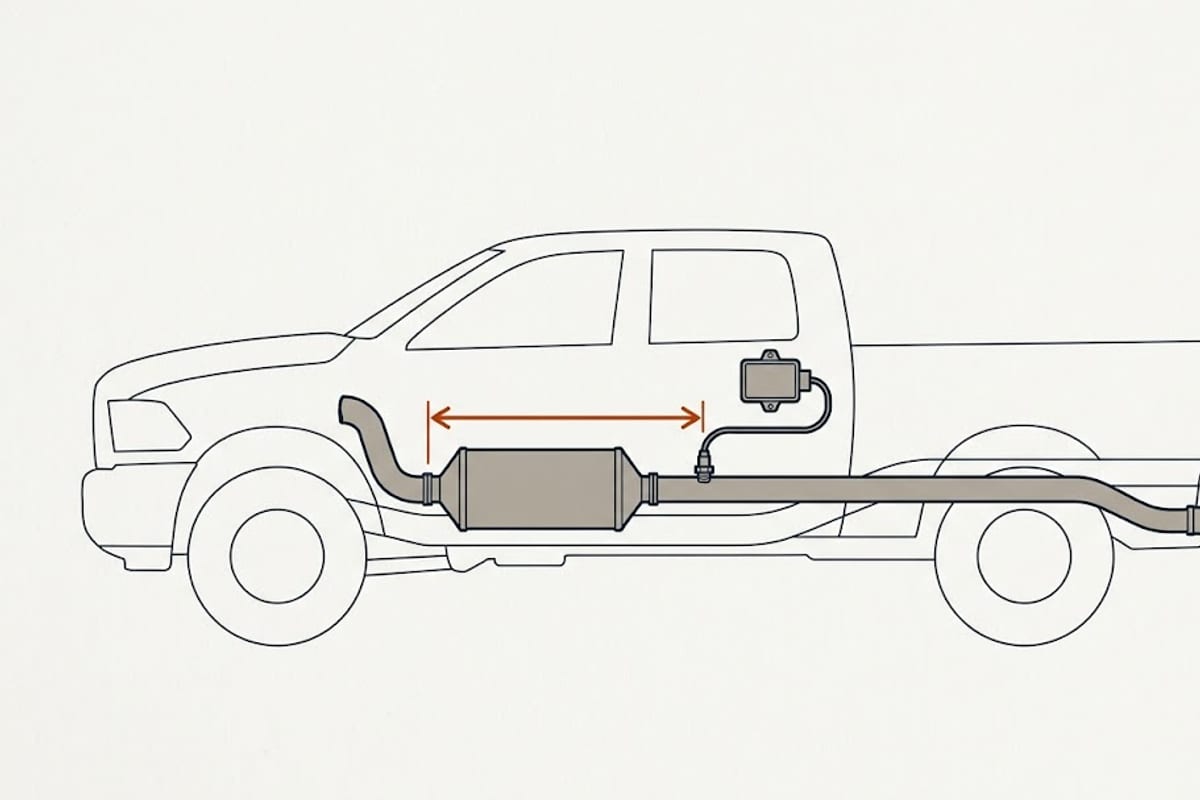
Where to find it:
- Ram 2500/3500 with the 6.7 L Cummins (2013 on): the probe is at the rear of the second DPF can, the module is on the frame nearby.
- Chevrolet Silverado / GMC Sierra HD with the Duramax (LML 2013 on, L5P 2017 on): probe behind the DPF, module on the frame rail.
- Ford Super Duty 6.7 L Power Stroke (2015 on): similar location.
- Hyundai and Kia diesels sold outside the US, and some European diesels, use the same architecture and the same generic code.
What happens when it sets
The module's job is emissions monitoring, not engine control, so the truck normally keeps running with no change in power. What you get is the check engine light, sometimes a "Service DEF system" or emissions warning on Ram trucks, and, because the PM monitor cannot run, an incomplete readiness monitor. That last point matters in states that inspect diesel emissions: a truck with U02A3 stored fails on readiness even after the code is cleared, until the PM monitor completes again. See readiness monitors and why clearing codes resets them.
On some calibrations, a persistent U02A3 will eventually trigger a derate or a countdown, because the ECM treats an unmonitorable DPF as a possible tampered one. That is the reason not to leave it alone.
Causes, most to least common
Connector and pigtail damage. The probe pigtail lives beside the exhaust. Heat-hardened insulation, a chafed wire where the harness crosses a bracket, and connectors filled with road salt spray are the majority of cases. Trucks that see winter roads set this code more often, and several Ram owners report it appearing first in cold weather, when contracted, brittle insulation opens an already-marginal connection.
The truck was recently deleted, or recently returned to stock. When an emissions delete removes the DPF, the PM sensor and its module are usually unplugged or removed with it. A truck later put back to stock, for a sale or for an inspection, frequently comes back with U02A3 because the module was never reconnected, the connector was left open to the weather, or the harness was cut. A Cummins Forum thread describes exactly this on a 2016 Ram 2500 that threw U02A3 after being returned to stock. If the truck's history includes a tune, this is the first thing to check.
Module power or ground. The PM module has its own ignition-switched supply and a ground on the frame. A corroded ground stud or a fuse shared with other emissions components silences it. Check for company: if U02A3 arrives with other U codes for exhaust-area modules (NOx sensors U029D, U029E; DEF components), the shared feed or the CAN branch is the suspect, not three modules at once. The logic is laid out in U codes and module communication.
The module itself. Heat and vibration do kill them. A dead module is usually a solid, current code that survives a clear and an ignition cycle, with no other U codes present.
A CAN branch fault. The PM module hangs on a CAN branch that also serves the NOx sensors and, on some trucks, the DEF pump. A damaged branch takes several of them offline together.
How to test it before replacing anything
- Read all codes and the freeze frame. Note whether U02A3 is current or history, and what else is stored. The freeze frame shows coolant temperature and vehicle speed at the time of the fault; a cold-start pattern points at a connector, a highway pattern at vibration.
- Find the module and inspect the connectors. Unplug both the module connector and the probe pigtail. Look for green corrosion, bent pins, melted plastic, and wires that pull free at the seal.
- Check for power and ground at the module connector, key on. Battery voltage on the supply pin, and less than 0.1 V of drop between the ground pin and the battery negative. No supply means a fuse or a splice, not the module.
- Check the CAN pair. With the key off and the module unplugged, measure resistance between CAN high and CAN low at the module connector. On a healthy bus you read about 60 ohms (two 120 ohm terminating resistors in parallel). An open branch reads 120 ohms or infinite.
- Look at the module on a scan tool. A capable tool lists the PM sensor module as a node and shows whether it responds. If it responds now but the code is in history, the fault is intermittent and the harness needs a wiggle test with the module data live on screen.
- Only then replace the sensor and module, and check whether the new module needs a learn or reset procedure. On Ram and GM trucks the PM sensor is sold as a unit with its module, and a replacement must complete a drive cycle before the readiness monitor sets.
What the code does not say
U02A3 says nothing about the DPF's condition. A cracked filter sets a different code (P2002, DPF efficiency below threshold). A missing PM module cannot report soot, so the DPF can be fine or gone and this code looks the same either way. It also does not say whether the fault is electrical, mechanical or a deliberate disconnection. The connector and the truck's history answer that; the point is developed in what a trouble code does not tell you.
Frequently asked questions
Can I drive with a U02A3 code?
Yes. The particulate matter sensor module only monitors the diesel particulate filter; it does not control fueling or boost. Power is unchanged. The risks are a failed emissions inspection because the PM monitor cannot complete, and on some trucks a derate countdown if the code stays active.
Where is the particulate matter sensor on a Ram 6.7 Cummins?
The probe sits in the exhaust at the rear of the second DPF can, and its control module is mounted on the frame nearby with a short pigtail. On Duramax and Power Stroke trucks the layout is the same: probe behind the DPF, module on the frame rail.
Why did U02A3 appear after my truck was put back to stock?
Emissions deletes usually unplug or remove the PM sensor and its module. When the truck is returned to stock, the module is often not reconnected, the connector has been open to the weather, or the harness was cut. Check the module connector and the pigtail before anything else.
Does U02A3 mean my DPF is bad?
No. A cracked or missing DPF sets P2002, DPF efficiency below threshold. U02A3 says the module that would report soot has stopped communicating, so the filter's condition is unknown until communication is restored.
Related codes
- P2002 / P2003: DPF efficiency below threshold (bank 1 / bank 2). The code the PM sensor exists to set.
- P24A0 to P24D1 range: PM sensor circuit, heater and regeneration codes. These describe a sensor that is talking but reading wrong; U02A3 describes one that has stopped talking.
- U029D / U029E: lost communication with NOx sensor 1 / 2. Same exhaust harness, same power feeds.
- U0100: lost communication with the ECM. If this is present, the whole bus is in trouble and U02A3 is a symptom.
For the meaning of each character in the code number, see how to read an OBD2 code number.