P056E means the boost control system did not do what the engine control module asked during a cold start. On Volkswagen and Audi engines, where this code is most common, the calibration is specific: the difference between the wastegate actuator's target position and its actual position exceeded 12 percent, in either direction, during the cold-start phase. The turbo did not necessarily fail. The wastegate did not move where it was told to, when the engine was cold.
Severity: moderate. Can you keep driving? Yes, with caution, for short distances. Boost is usually normal once the engine is warm. A stiff wastegate arm gets worse, and a wastegate that sticks fully open or closed means no boost or an overboost cut, so this is a code to diagnose within the week.
Why there is a separate cold-start test
Modern turbocharged gasoline engines use the turbo during warm-up to heat the catalytic converter faster. The engine computer opens the wastegate on a cold start to send more exhaust energy past the turbine and into the catalyst, then closes it progressively as the catalyst lights off. The wastegate is held in a precise, partially-open position for the first minute or two after a cold start.
That position is commanded, on the VW/Audi EA888 engines from about 2015 on, by an electric wastegate actuator with a position sensor. The computer knows where it asked the flap to be and where the flap actually is. If the two differ by more than the threshold during this cold phase, P056E is stored. The same actuator with the same stiffness passes the warm tests, because the exhaust heat has expanded the linkage and loosened it.
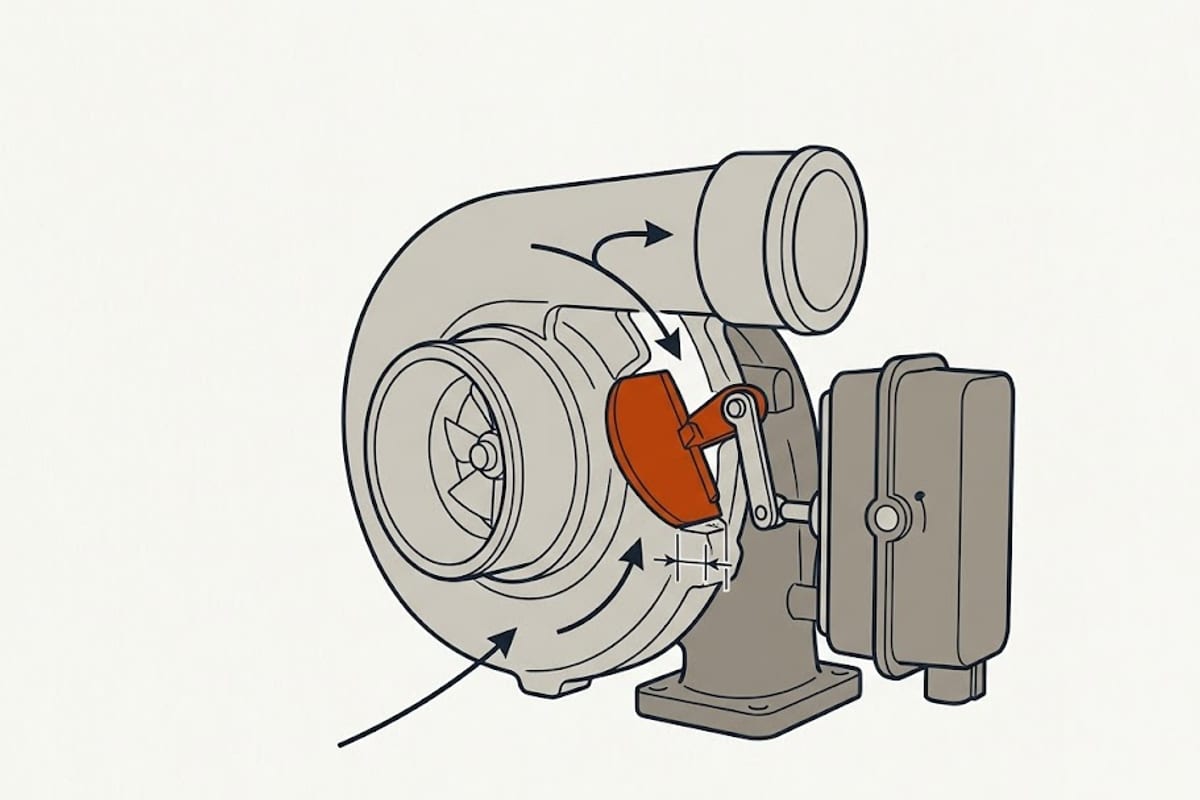
That is why this code has a pattern: it sets on the first start of the day, often on a cold morning, sometimes with the EPC light on VW models, and is usually gone as a current fault once the engine is warm.
Engines that set it
- VW and Audi EA888 Gen 3 2.0 TSI and 1.8 TSI (2015 on in North America: Golf, GTI, Jetta, Passat, Tiguan, A3, A4, Q3, Q5). The electric wastegate actuator with position feedback makes this test possible.
- Other manufacturers with electric or position-sensed wastegates use P056E too, but the VW/Audi population dominates the reports. A technician on iATN in 2024 described a 2014 Jetta SEL 1.8 T with the EPC light, P056E and a turbo that did not seem to work correctly; that is the typical presentation.
Causes, most to least common
A seized or stiff wastegate pivot arm. The wastegate flap sits inside the turbine housing and its shaft passes through a bushing in the housing wall. Exhaust heat cycles, water and road salt corrode the shaft where it exits the housing. On the EA888 this is the well-known failure, discussed at length on VW Vortex and Audizine. The actuator strains against a stiff arm, cannot reach the commanded position in the time allowed, and the position error trips the code. Left alone, the arm eventually sticks completely and a boost-deviation code (P2563, P0299 or P1556) follows.
The actuator itself. The electric actuator contains a small motor, a gear train and a position sensor. Gear wear or a failing position sensor produces a position reading that lags or jumps. A scan tool shows the actual position hunting or failing to follow the target even with the arm free.
Wiring and connector. The actuator's connector sits on the turbo, one of the hottest places in the engine bay. Heat-hardened insulation and corroded pins produce a position signal that drops out intermittently.
A boost pressure control solenoid (N75) or vacuum leak on engines with pneumatic wastegates. On those engines P056E can be a vacuum problem rather than a mechanical one. The EA888 Gen 3 uses the electric actuator, so this does not apply to it, but the older 2.0 TFSI does use a vacuum-operated wastegate.
Binding in the linkage after a turbo replacement. A new turbo whose actuator was not calibrated, or whose linkage was adjusted, sets P056E on the first cold start. The actuator needs the adaptation or basic setting procedure performed with a scan tool after installation.
How to diagnose it
- Read the freeze frame first. Confirm the fault set cold: coolant temperature near ambient, low engine speed, low vehicle speed, seconds after start. If the freeze frame shows a warm engine, the problem is not a cold-start stiffness and the actuator or wiring moves up the list. How to interpret the snapshot: freeze frame data.
- Watch actuator target and actual position on a scan tool, engine cold. VCDS, ODIS or a capable generic tool shows both. Start the engine cold and watch the two values for the first two minutes. A stiff arm shows the actual position lagging behind the target and then catching up as the exhaust heats. A dead actuator shows no movement at all.
- Run the actuator test with the engine off. Most scan tools can command the actuator through its range. Watch the arm on the turbo: it should sweep smoothly. Hesitation, a jerky motion or a motor that strains and stops is the arm, not the actuator.
- Check the arm by hand, engine cold, key off. Disconnect the actuator rod at the arm (on the EA888 it is a clip). The arm should move freely through its arc by finger pressure. Any stiffness fails it. A stiff arm can sometimes be freed with penetrating oil and repeated working, but the corrosion returns; the durable repair is a wastegate arm rebuild or a turbine housing replacement.
- Inspect the actuator connector and harness for heat damage and corrosion.
- After any repair, perform the actuator adaptation and confirm with at least two full cold starts, watching the position error. One warm restart proves nothing for this code.
The mistake to avoid
Replacing the turbocharger for P056E without checking the arm and the actuator first. On the EA888 the actuator is a separate, replaceable part, and the arm can be freed or rebuilt. A full turbo is the most expensive answer, and it is the right one only when the turbine housing bushing is worn oval and the shaft cannot be made to seal.
Do not clear the code and hope. A stiff arm progresses to a stuck one, and a stuck-open wastegate means no boost at all, while a stuck-closed one means overboost and the engine computer cutting power to protect itself. Clearing also resets the readiness monitors.
What P056E does not tell you
It does not say the turbo is bad. It says the position error was too large during the cold phase. It does not say whether the error was mechanical, electrical or a missing adaptation. The live position data and the arm test answer that. It also does not say whether boost was actually low or high while driving; that is what the deviation codes below report. The general principle is in what a trouble code does not tell you.
Frequently asked questions
Can I drive with a P056E code?
Yes, cautiously and for short distances. The fault is measured only during the cold-start phase, and boost control is usually normal once the engine is warm. The reason not to wait is that a stiff wastegate arm progresses to a stuck one, and a stuck wastegate means no boost at all or an overboost power cut.
Is P056E a bad turbo?
Not usually. On the VW and Audi EA888 engines where this code is most common, the wastegate pivot arm has seized from corrosion or the electric actuator has worn. Both are repairable without replacing the turbocharger. A turbo is the answer only when the turbine housing bushing is worn oval.
Why does P056E only set on cold mornings?
The engine computer holds the wastegate partly open during a cold start to heat the catalytic converter quickly, and it compares the commanded position with the actual position. A stiff arm cannot reach the target in the time allowed while cold, but expands and loosens as the exhaust heats, so warm-engine tests pass.
What should I check first for P056E?
With the engine cold, watch actuator target and actual position on a scan tool through the first two minutes after start. Then disconnect the actuator rod and move the wastegate arm by hand: any stiffness is the fault. Check the actuator connector for heat damage before condemning the actuator itself.
Related codes
- P2563: Turbocharger boost control position sensor circuit range/performance. The same actuator's position sensor reading badly at any temperature.
- P0299: Turbocharger underboost. Measured boost below target while driving.
- P1556 (VW/Audi): Charge pressure control, negative deviation. The manufacturer-specific underboost code.
- P0234: Turbocharger overboost. A wastegate stuck closed.
- P0045 to P0049: Turbo boost control circuit codes, for the electrical side of the actuator.
Code structure and what each character means: how to read an OBD2 code number.