P04FC means the engine control module compared the crankcase pressure it measured with the pressure it expected, and the two disagreed for long enough to matter. The code belongs to the auxiliary emission controls range, and it appears only on engines that carry a crankcase pressure sensor. On engines without that sensor, a ventilation problem shows up as a lean code, an oil leak or a smoking dipstick; it never becomes P04FC.
Severity: low to moderate. Can you keep driving? Yes, but not for long. Rising crankcase pressure pushes oil past seals and, on some engines, into the intake. Read the crankcase pressure on a scan tool and fix the restriction within days rather than weeks.
Why the crankcase is monitored at all
Every engine leaks a little combustion gas past the rings into the crankcase. Left alone, that blow-by pressurizes the crankcase, pushes oil out through the seals, and carries fuel and water vapor into the oil. The positive crankcase ventilation (PCV) system draws those gases out with intake vacuum and burns them.
Since the mid-2010s, emissions rules require the engine computer to prove the ventilation system is connected and working, because a disconnected PCV hose vents hydrocarbons to the air. Manufacturers met that requirement in two ways: a hose-connection detection code (P04DB, crankcase ventilation system disconnected), and a pressure sensor in the crankcase or the valve cover that lets the module check the system's performance directly. P04FC is the performance code from that sensor.
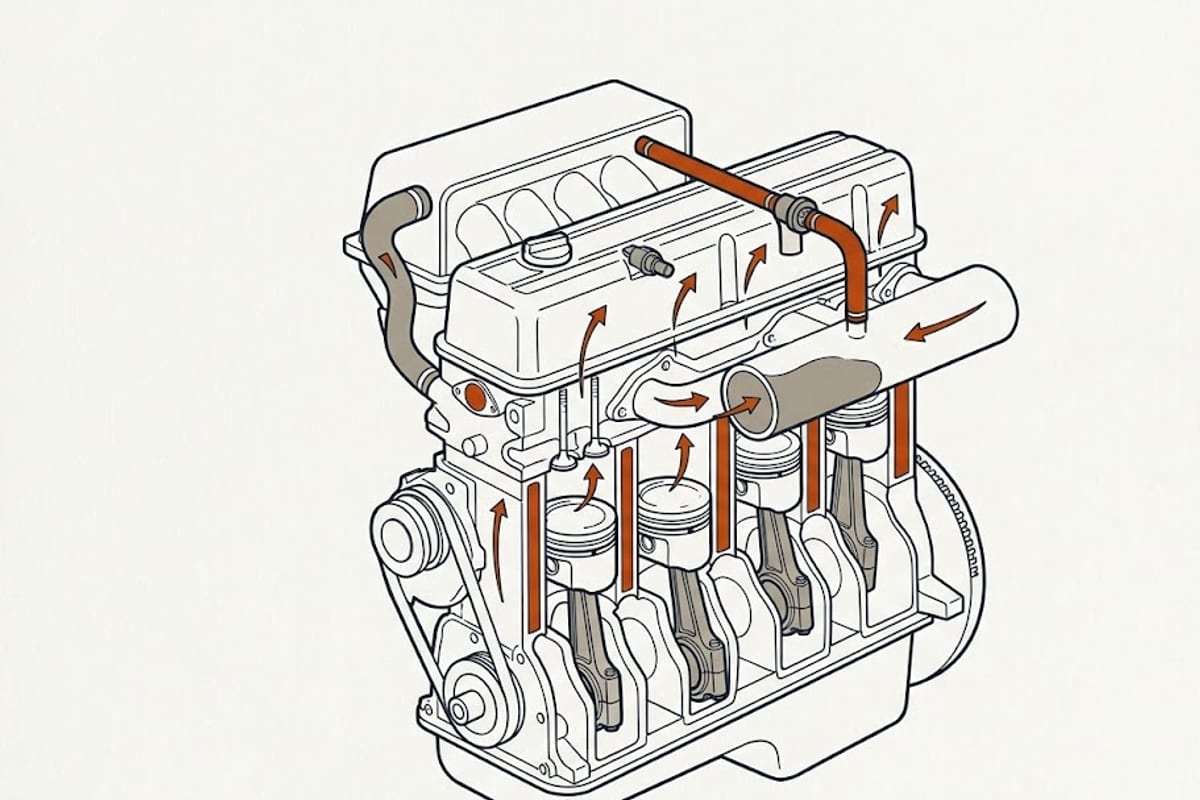
Engines known to carry a crankcase pressure sensor and set this family of codes include:
- Ram ProMaster 3.0 L EcoDiesel (2014 to 2015): owners on the ProMaster forum report P04FC on this engine, which uses a closed crankcase ventilation (CCV) filter that clogs with age.
- Ram, Jeep and Chrysler 3.6 L Pentastar and 5.7 L Hemi (later years): crankcase pressure sensor on the valve cover; PCV valve is a serviceable cartridge.
- Cummins 6.7 L in Ram HD trucks: CCV filter with a service interval; the pressure monitor flags a saturated filter.
- Ford EcoBoost and Power Stroke engines: Ford tends to use P04DB and P04FB for the same system, so a Ford with a ventilation problem usually shows those instead.
What the sensor sees in each failure
The value of this code is that the sensor's live reading, on a scan tool, sorts the causes before you touch anything. Crankcase pressure at idle on a healthy engine is slightly negative, a few inches of water below atmosphere, and rises toward zero or slightly positive at load.
Pressure too high (positive at idle). Something is stopping the gases from leaving.
- A clogged CCV or breather filter. On the diesel engines above, this is the single most common cause and it is a maintenance item that gets skipped. The filter element is typically inside a housing on the valve cover.
- A PCV valve stuck closed, or a plugged PCV hose. On the Pentastar and Hemi the PCV valve is a cartridge on the valve cover; a screwdriver-and-carburetor-cleaner test does not apply, it is replaced as a unit.
- Excessive blow-by from worn rings or a damaged cylinder. This is the cause everyone fears and the least common. Excess blow-by usually comes with oil consumption and smoke, and a compression or leak-down test confirms it before any conclusion is drawn.
Pressure too low (strong vacuum at idle). Intake vacuum is reaching the crankcase without restriction.
- A PCV valve stuck open. Intake vacuum pulls hard on the crankcase, oil is drawn into the intake, and the idle is often rough. On turbocharged engines this can also show up as an oil-coated intercooler.
- A collapsed or missing check valve in the vent line.
Pressure that does not track engine load. The sensor reads a fixed value regardless of RPM.
- A hose split or a fitting disconnected between the crankcase and the sensor, so the sensor reads atmosphere.
- The sensor itself, or its connector. Oil mist does reach the sensor and a sensor that has drifted reads wrong at every load.
A diagnostic order
- Record the freeze frame. The engine speed, coolant temperature and load at the time of the fault separate a cold-start problem (ice in a breather hose, a thick oil condition) from a highway one. How to read it: freeze frame data.
- Watch crankcase pressure live, at idle, at 2,500 RPM held, and on a snap throttle. Compare with the direction the failures above predict. If your scan tool does not show the parameter, the sensor's signal wire can be read with a meter against the manufacturer's spec, but the scan tool is far quicker.
- Do the oil-cap test. With the engine idling, loosen the oil fill cap. On a healthy engine it is held down lightly by vacuum and a faint hiss is heard when it lifts. A cap that pops up, or oil mist puffing out, is positive crankcase pressure, confirming a restriction or blow-by. A cap sucked down hard is excessive vacuum, a PCV stuck open.
- Inspect the ventilation path. Follow the hose from the valve cover to the intake. Squeeze it, look for cracks at the bends, check the fittings. On engines with a CCV filter, open the housing and look at the element; if it is black and wet, it is done.
- Test or replace the PCV valve. For cartridge valves, replacement is the test. For conventional valves, rattle and vacuum tests work.
- Only if pressure is high with a clean filter and a good valve, run a compression and leak-down test before talking about rings.
- Sensor last. If the live reading is implausible in every condition, unplug the sensor and check its supply (usually 5 V), ground, and the signal wire for chafing where the harness crosses the valve cover.
Do not clear it and drive
Two reasons. A clogged breather that keeps raising crankcase pressure will push oil past the rear main seal and the front cover, and those leaks cost far more than a filter. And the ventilation monitor is part of the emissions readiness set; a cleared code with an incomplete monitor still fails an inspection. See why clearing codes resets the readiness monitors.
What the code does not tell you
P04FC does not name a part. It does not say high or low; the sensor's reading does. It does not say whether the system is disconnected (that is P04DB) or restricted. Like every code, it identifies the test that failed, not the component that failed it, a distinction explored in what a trouble code does not tell you.
Frequently asked questions
Can I drive with a P04FC code?
Yes, for a short period. The engine runs normally, but if the cause is a clogged breather filter or a stuck PCV valve, crankcase pressure keeps rising and starts pushing oil past the rear main seal and the front cover. Those leaks cost far more than the filter or valve that caused them.
What is the difference between P04DB and P04FC?
P04DB, crankcase ventilation system disconnected, is set when the computer detects the hose is unplugged or split. P04FC, crankcase ventilation system performance, is set when the crankcase pressure sensor reads a value the computer did not expect, which points at a restriction, a stuck valve or the sensor rather than a disconnected hose.
Which engines set P04FC?
Engines with a crankcase pressure sensor: the Ram ProMaster 3.0 L EcoDiesel, later Ram, Jeep and Chrysler 3.6 L Pentastar and 5.7 L Hemi engines, and the Cummins 6.7 L with its closed crankcase ventilation filter. Ford engines with the same monitor tend to set P04DB and P04FB instead.
How do I check crankcase pressure without a scan tool?
Loosen the oil fill cap at idle. On a healthy engine the cap is held down lightly and hisses faintly when lifted. A cap that pops up or puffs oil mist means positive pressure, a restriction or blow-by. A cap sucked down hard means excessive vacuum, usually a PCV valve stuck open.
Related codes
- P04DB: Crankcase ventilation system disconnected. The hose-detection code; a split or unplugged hose sets this first.
- P04FB: Crankcase ventilation hose connection pressure sensor range/performance. Ford's version of the same monitor.
- P052E: Positive crankcase ventilation regulator valve performance. Set on engines with an electrically controlled PCV regulator.
- P0171 / P0174: System too lean. A large PCV vacuum leak on a gasoline engine often sets a lean code before it sets P04FC. The lean side is explained in P0171 and vacuum leaks.
Code structure and what each character means: how to read an OBD2 code number.