P0420 — catalyst system efficiency below threshold, bank 1. P0430 is the same test on bank 2.
Read literally it says the catalytic converter has failed. That is one of the things it can mean, and it is the most expensive one, which is why this code sells more converters than it should.
What the module actually measures
There is no sensor inside a catalytic converter. The module infers the converter's health by comparing two oxygen sensors.
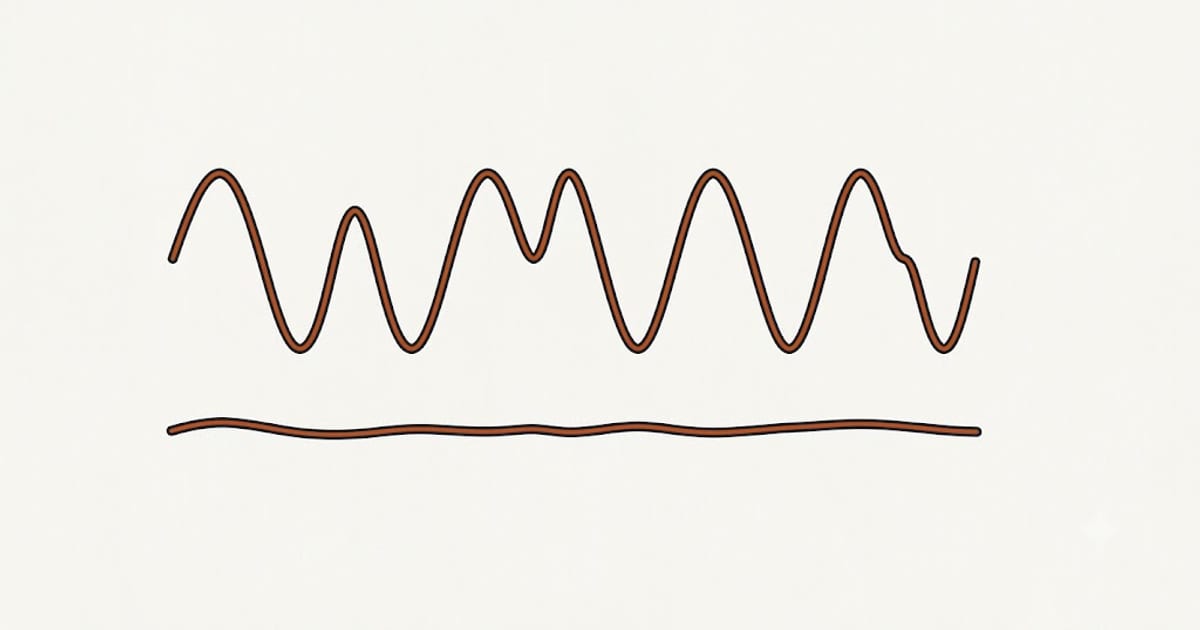
Sensor 1, upstream of the converter, sees the exhaust as it leaves the engine. Under closed-loop fuelling its signal swings rapidly between rich and lean — that oscillation is the fuelling system working correctly.
Sensor 2, downstream, sees the exhaust after the converter. A healthy converter stores and releases oxygen, which smooths those swings out. The downstream trace should be comparatively flat and lazy.
The module compares the two. If the downstream trace looks too much like the upstream one, it concludes the converter is not doing its job and sets P0420.
That is an inference about a comparison, not a measurement of the converter. Anything that makes the two traces look alike sets the code.
The five things that set it
A genuinely failed converter. The substrate is cracked, melted or its coating is spent. This is the real thing, and it does happen — usually after 100,000 miles, or much sooner after a misfire.
A lazy or failed downstream sensor. A sensor that has slowed with age produces a flatter trace no matter what the converter is doing — or, if it has become erratic, a trace that swings when it should not. Downstream sensors are typically far cheaper than converters, and a scan tool showing sensor 2 mirroring sensor 1 in real time is a strong hint.
An exhaust leak. A crack, a bad gasket or a rotten flexi joint upstream of sensor 2 lets fresh air in. The sensor reads that extra oxygen and the comparison fails. Exhaust leaks are frequently audible on a cold start and gone once the metal expands, which is why a code that sets only on short trips is worth listening for.
A rich condition. An engine that has been running rich — leaking injectors, high fuel pressure, a failing coolant temperature sensor — overloads the converter with unburnt fuel. Long enough and the converter really does fail. Fit a new one without fixing the cause and the new one goes the same way.
A misfire. Raw fuel reaching the converter burns inside it and melts the substrate. This is the mechanism behind the flashing check engine light warning, and a P0420 that appears shortly after a misfire code was ignored usually has exactly this history.
The order that avoids paying twice
- Read every stored code, not just this one. Misfire codes, fuel trim codes or a coolant temperature code alongside P0420 name the real problem, and P0420 is the consequence.
- Check fuel trims. Long-term trims well away from zero say the mixture has been wrong, which points at cause rather than symptom.
- Listen and look for exhaust leaks, cold, before the joints seal up.
- Watch both oxygen sensor traces live. A downstream sensor swinging in step with the upstream one is the classic converter-or-sensor decision point, and swapping in a known-good sensor is far cheaper than swapping in a converter.
- Only then consider the converter.
Why it so often appears at exactly the wrong moment
P0420 is a slow-setting code. The catalyst monitor needs a fully warm engine and a sustained steady cruise, so it may only run once on a long trip and not at all during a week of short journeys.
The practical effect is that the code frequently first appears on a long drive, and frequently just before an emissions test — because the monitor finally got the conditions it needed. The converter did not fail that morning; the test simply ran for the first time in weeks.
Cheap converters and the code that comes back
An aftermarket converter that meets the emissions standard on paper may still hold less oxygen than the original. On some vehicles, particularly where the monitor's threshold is tight, a legal replacement part sets P0420 again within a few hundred miles.
This is not a fault in the diagnosis; it is a mismatch between the part and the threshold. It is also a good reason to be certain the converter is the problem before buying one, and to check what the vehicle is known to accept.
What it is not
P0420 is not a safety issue and not a reason to stop driving. It is an emissions code, and on its own the car will drive normally.
It will, however, fail an emissions test — and clearing it before the test does not help, because clearing it also resets the readiness monitors and the catalyst monitor is one of the slowest to set again.